
The best kitchen tongs for gripping, flipping, and everyday cooking

Kitchen tongs are one of those tools that quietly do everything: they flip steaks, fish pasta out of boiling water, turn shrimp in a pan, and help you move hot dishes without burning your fingers. When they work well, you hardly notice them. When they don’t, you fight the spring, drop food, and nick your cookware.
To find out which models are actually worth buying, more than 40 pairs of kitchen tongs were tested side by side. They were used to lift whole chickens, transfer spaghetti, flip shrimp, and move hot ramekins, then assessed for comfort, control, and ease of cleaning. A few clear winners emerged, along with some helpful rules for choosing the right tongs for your own kitchen.
The top kitchen tongs
Best overall: OXO Good Grips 12-inch Tongs
The clear winner was the classic OXO Good Grips 12-inch stainless steel tongs. In testing they felt solid and balanced, with a spring that bounced back without tiring the hand. The metal arms stayed straight and didn’t twist under the weight of a whole chicken, and the scalloped tips were thin enough to pinch individual shrimp yet wide enough to scoop up big bundles of pasta.
The rubberized handles gave a secure grip even with damp hands, and the simple pull-tab lock at the end worked smoothly. The main drawback is that bare metal tips don’t cradle delicate items like ramekins as securely as silicone, and the ridges inside the arms can trap a bit of food, so they need a touch more attention when hand-washing. Overall, though, they were the most versatile and dependable pair tested.
Best for nonstick pans: OXO Good Grips 12-inch Silicone Tongs
For anyone who cooks on nonstick or ceramic-coated pans, the silicone-tipped OXO Good Grips 12-inch tongs are a smart choice. They share the same basic design as the stainless model—comfortable handles, sturdy metal core, and the familiar pull-tab lock—but the heads are fully wrapped in soft, heat-resistant silicone.
The silicone coating (rated up to 600°F) protected nonstick surfaces and gently gripped curved items like ramekins without slipping or chipping the ceramic. Because the coated heads are slightly thicker and more rounded, they felt a bit less nimble than bare metal when flipping small pieces like shrimp, but the trade-off in protection and grip on bulky items was significant.
Best mini tongs: OXO Good Grips Mini Tongs
Full-size tongs can be overkill for small, everyday jobs, which is where the OXO Good Grips Mini Tongs shine. At around 8.5 inches, they are compact but still built like a scaled-down version of the main OXO model: strong metal arms, precise scalloped edges, and a simple locking tab.
They’re particularly handy for reaching into jars, serving small portions of leftovers, grabbing items from food containers, or putting out snacks and side dishes at the table. They’re not meant to replace a standard 12-inch pair for cooking over high heat, but they cover a surprising number of small tasks very well.
Best for grilling: OXO Good Grips Grilling Tongs
At the grill, longer reach becomes essential. The OXO Good Grips grilling tongs extend to about 16 inches, keeping hands farther away from flare-ups while still feeling controllable. They held onto hot dogs and kebabs securely and were sturdy enough to move heavier items across a hot grate.
These tongs also use a pull-ring lock and include a hook for hanging from the grill or a tool rack. The only minor downside is that the all-metal locking ring isn’t as cushioned as the rubber-tipped version on OXO’s standard kitchen tongs, but in practice this was a small comfort issue rather than a performance problem.
How the tongs were tested
To separate excellent tools from merely okay ones, the tongs were put through a series of real-world cooking tasks that revealed how they behaved with different shapes, textures, and weights.
- Whole chicken test: Each pair had to lift a raw six-pound chicken into a cast iron pan and transfer the cooked bird to a cutting board. This showed how well the tongs supported large, heavy, and slippery foods and whether the edges tore the skin.
- Spaghetti test: Tongs were used to move cooked spaghetti from pot to bowl and to grab single strands. This highlighted how well they handled slippery foods and how precise the tips were.
- Shrimp test: While searing shrimp, each pair was used to flip the small pieces individually, revealing how careful and agile the tips felt in a crowded pan.
- Ramekin test: Tongs had to lift an empty ramekin and hold it for 10 seconds, then repeat the test with the ramekin filled with water. This checked stability and grip on smooth, rounded dishes—one of the hardest tasks for poor designs.
Throughout all of this, comfort, spring tension, locking mechanisms, and ease of cleaning were also assessed, both during cooking and when hand-washing the tools.
Silicone vs. stainless steel tips
One of the biggest decisions when buying tongs is whether to choose bare stainless steel or a silicone (or nylon) coating on the heads. Both styles have clear strengths and weaknesses.
When silicone-tipped tongs are best
Silicone- or nylon-coated tongs are kinder to cookware. Their softer edges won’t scratch nonstick or ceramic pans, and they’re gentler on enameled Dutch ovens. In testing, models with soft silicone heads—such as the winning OXO silicone tongs—handled curved items impressively well. The slightly pliable coating conformed to the sides of ramekins, helping prevent tipping and spills.
The trade-off is bulk: the extra material makes the heads thicker and heavier. This extra heft improves leverage on big items like whole chickens but slightly reduces finesse when turning very small pieces. Heat tolerance also matters; while high-quality silicone can handle high temperatures, many coated tongs top out around 450°F, so always check the manufacturer’s rating.
When stainless steel tongs excel
Uncoated stainless steel tongs are lighter and more precise. Their thinner tips can slip under small shrimp tails or snag a single strand of spaghetti with ease, making them ideal for tasks that require fine control. They’re also entirely metal, so there’s no risk of a coating deforming near direct heat.
The downside is that rigid metal doesn’t grip smooth, heavy dishes well. In the ramekin test, every unlined steel pair struggled to keep a firm hold and often caused the dish to slip. Steel tips can also scratch nonstick coatings and chip or mark enamel if used roughly. For anyone who regularly uses nonstick cookware, silicone-tipped tongs are the safer choice.
In practice, the most flexible setup is to keep one good stainless steel pair and one silicone-tipped pair in your kitchen. Between them, you can tackle both delicate cookware and precision tasks comfortably.
Why tip shape matters
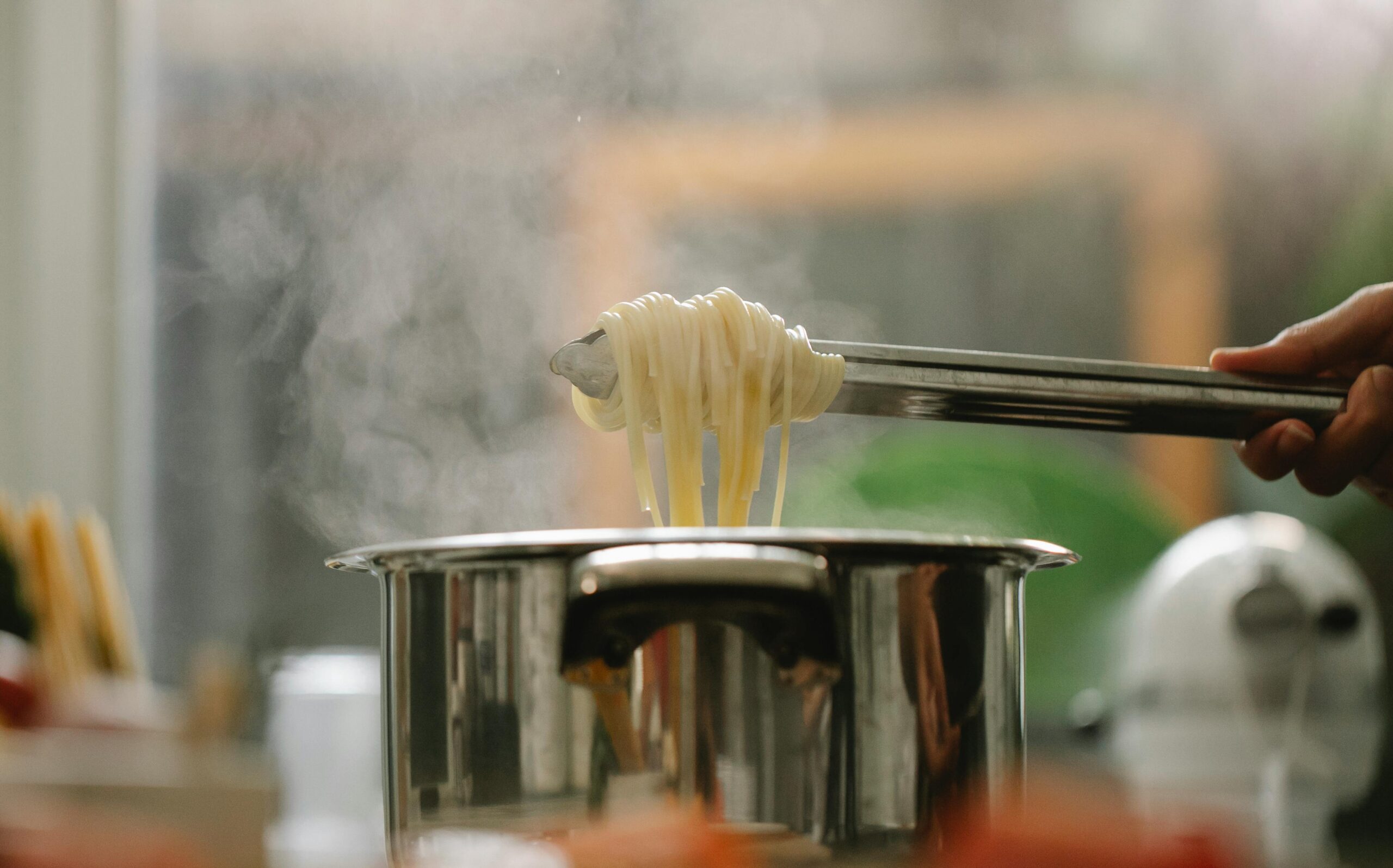
Beyond the material, the shape of the tong heads makes a huge difference in performance.
- Aligned tips: The two sides should meet cleanly so they can pinch food accurately. Even a slight misalignment makes it harder to grab small items.
- Scalloped edges: Gently scalloped edges increase grip by creating multiple small contact points. This concentrates pressure where it’s needed and helps hold onto slippery foods.
- Curved, not flat, heads: Heads that are slightly concave, with the edges touching first, concentrate force along the tips. This design holds pasta, meat, and vegetables more securely. By comparison, very flat, paddle-like heads spread pressure out and often let foods slide right out of the tongs’ grasp.
- Rounded, not sharp, edges: Tips should be flat or gently rounded. Very sharp or angled edges can cut into food—tearing chicken skin or shredding noodles—rather than holding them.
Top-performing tongs, such as the OXO and some professional utility models, combined scalloped edges, aligned tips, and gently curved heads. Poorly designed versions with flat or sharply angled heads tended to drop almost everything they tried to hold.
Locks and spring tension: comfort counts
A good pair of tongs should open and close easily without straining your hand. Two details—locking style and spring strength—make a big difference in how pleasant they are to use day after day.
Pull-tab locks
The most common design uses a pull-tab at the end of the handle: pull to lock, push to unlock. This usually takes two hands to engage, but experienced cooks often unlock them by tapping the end against the counter or their hip. When the lock slides smoothly, this system is reliable and simple.
Problems arise when the lock is too stiff or sticky. Some tested models required so much force to move the mechanism that they were frustrating to open and close mid-cook. In practice, this led to leaving the tongs unlocked on the counter, which takes up more space and can be awkward to store.
Gravity and one-handed locks
Some tongs use a gravity or one-handed lock that responds to how you hold them. For instance, squeezing the arms while pointing downward can release the lock, while pointing upward engages it. This can be useful for people with limited dexterity or for quick adjustments with only one free hand.
However, these mechanisms can be less dependable. In testing, a few one-handed models tended to pop back open after being locked or didn’t catch properly the first time. When the lock won’t hold, it undermines one of the main reasons to have it.
Spring strength
The spring should feel responsive but not rigid. If it’s too strong, your hand tires quickly, especially when holding the tongs closed around heavy or bulky items. A well-balanced spring, like those in the winning OXO models, rebounds easily without putting excessive strain on your grip.
Choosing the right length
Length affects both safety and control. For everyday cooking on the stove, tongs around 12 to 14 inches long hit the sweet spot: your hand stays clear of heat and splatters, but you can still maneuver easily in a pan or pot.
Shorter tongs, such as the OXO Mini Tongs, are excellent for serving or reaching into containers but put your hand closer to heat, so they’re less suitable for tasks like searing steaks or tossing food in a very hot skillet.
For outdoor grilling or broiling, longer tongs—around 16 inches—are more comfortable and safer. They allow you to turn food over a hot grill or move charcoal without leaning into the heat.
Heat resistance and care
Most quality kitchen tongs are designed to handle high cooking temperatures, but how they behave around heat still matters.
- Heat tolerance: Stainless steel is fully heat-resistant but also highly conductive, so metal tongs left perched on the side of a hot pan or resting over a burner will quickly become too hot to hold. Silicone- or nylon-coated tips are generally safe up to their stated maximum (often 450°F to 600°F) but shouldn’t be exposed directly to open flame.
- Cleaning: Many tongs are labeled dishwasher-safe, including the recommended models. However, frequent cooks often hand-wash them so they’re ready to use again immediately. Soaking in warm, soapy water helps loosen any burnt-on bits before scrubbing.
Key buying criteria for kitchen tongs
Based on the full round of testing, these features are worth looking for when you’re shopping:
- Length: For everyday use, choose 12–14 inches; for grilling, about 16 inches; for jar and serving tasks, a compact mini pair is helpful.
- Head shape: Curved, slightly concave heads with scalloped, aligned edges provide strong grip on both large and small foods.
- Tip material: Bare stainless steel is ideal for precision and high heat (as long as you avoid nonstick surfaces). Soft silicone tips are better for protecting coated cookware and gripping smooth or delicate items.
- Comfortable handles: Rubberized or textured grips help keep the tongs steady in slippery or greasy situations.
- Reliable lock: A smooth, easy-to-use locking mechanism keeps tongs compact in a drawer and less awkward when you set them down mid-recipe.
For most home cooks, keeping one solid stainless-steel pair and one silicone-tipped pair covers almost every situation, from delicate pans to heavy roasts and outdoor grilling.
Do you really need kitchen tongs?
While spatulas and forks can get you part of the way, a good pair of kitchen tongs is hard to replace. They make it easier to toss salad greens, lift pasta from boiling water, flip vegetables and meats without piercing them, and move hot dishes or baking tins more safely.
For grill enthusiasts, a long pair of sturdy tongs is almost essential equipment. They’re used to place and turn steaks, sausages, and skewers, and even to rearrange charcoal or wood pieces. Once you get used to reaching for them instinctively, they quickly become one of the most-used tools in the kitchen.



0 comments